Best Heavy Duty Gas Hedge Trimmer for Big Hedges

Seven gas hedge trimmers compared on published blade length, weight and handle rotation, with the Husqvarna 122HD60 taking the top spot and a 9.4 lb alternative for anyone cutting above shoulder height.

By Bailey CunninghamUpdated 20 min read
On this page
- Heavy duty gas hedge trimmer picks at a glance
- How I cut the field down to seven
- Does blade length actually decide it?
- 1. Husqvarna 122HD60 21.7cc Gas 23.7-in Dual Action Hedge — Best overall
- 2. SENIX 4QL 26.5cc 22-Inch Gas Hedge Trimmer — Best for families
- 3. Husqvarna 122LKH Gas Hedge Trimmer — Best upgrade
- 4. PROYAMA Gas Powered Hedge Trimmer — Most versatile
- 5. Baotree 24-Inch 36cc 2 Cycle Gas Powered Dual Sided Hedge — Best minimal setup
- 6. Baotree 24-Inch 26cc 2 Cycle Gas Powered Dual Sided Hedge — Best for pros
- 7. TdiriNar 2 Cycle Gas Hedge Trimmer — Best budget pick
- Weight is the specification that limits your session
- What does a rotating rear handle really change?
- Two-cycle or four-cycle: which do you want?
- What none of these listings tell you
- The verdict
- FAQ
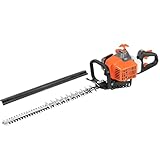
The best heavy duty gas hedge trimmer is the Husqvarna 122HD60, a 21.7cc two-cycle machine with 23.7-inch dual action blades and a published weight of 16.2 lb. If your cutting happens above shoulder height, the 9.4 lb SENIX 4QL is the better buy, because the weight you hold up matters more than the engine you carry.
Most buyers compare engine displacement first. That is the wrong opening question. A 36cc engine and a 21.7cc engine will both chew through a 1-inch branch, and neither will save your forearms at minute forty of a long hedge run.
Heavy duty gas hedge trimmer picks at a glance
| Pick | Blade / engine | Weight | Price |
|---|---|---|---|
| 23.7 in blade 21.7cc |
16.2 lb | Check Price | |
Best for families SENIX 4QL 26.5cc 22-Inch Gas Hedge Trimmer |
22 in blade 26.5cc 4-cycle |
9.4 lb | Check Price |
Best upgrade Husqvarna 122LKH Gas Hedge Trimmer |
21 in blade 89.7 in long body |
15 lb | Check Price |
Most versatile PROYAMA Gas Powered Hedge Trimmer |
25 in blade claim 25.4cc |
11.7 lb claim | Check Price |
Best minimal setup Baotree 24-Inch 36cc 2 Cycle Gas Powered Dual Sided Hedge |
24 in blade 36cc |
16 lb | Check Price |
| 24 in blade 26cc |
42 in body length | Check Price | |
Best budget pick TdiriNar 2 Cycle Gas Hedge Trimmer |
25 in blade claim 22cc |
44.5 in body length | Check Price |




How I cut the field down to seven
Three things got listings cut before I compared anything else.
The first was blank specification sheets. A hedge trimmer listing that publishes no blade length, no engine size and no weight gives you nothing to compare, and there are dozens of them in this category. Every pick here publishes at least two of those three figures.
The second was single-sided blades. All seven picks run dual action or double-sided cutting bars, so the blade moves against itself rather than against a fixed bar. That is the baseline for a heavy duty gas hedge trimmer, and it filtered out a surprising number of cheap machines.
The third was multi-seller confusion. Every one of these seven has just one seller listing it, which means the listing you read is the listing you buy from. No guessing which of five merchants ships the real thing.
What survived splits cleanly into three groups: two Husqvarna machines with genuine spec sheets, two Baotree units sharing a model code, and three lighter mid-field options from SENIX, PROYAMA and TdiriNar. The keyword says heavy duty, and I should be straight with you: Amazon's own results do not filter for a duty rating, and none of these listings publishes one. So "heavy duty" here means what the published numbers can actually show, which is blade length, displacement, blade capacity claims and build materials. You judge duty class from those, not from the word.
Does blade length actually decide it?
Blade length is the number every listing leads with, and it is the number that misleads most. The spread across this set is narrow: 21 in on the Husqvarna 122LKH, 22 in on the SENIX, 23.7 in on the 122HD60, 24 in on both Baotree units, and 25 in claimed by PROYAMA and TdiriNar. That is four inches between the shortest and longest. On a 60-foot hedge, four inches of bar changes your pass count by a rounding error.
What actually decides a heavy duty gas hedge trimmer purchase is the combination of weight and where the hedge sits relative to your shoulders. Here is why.
- Below waist height, weight barely matters. The machine rests on the hedge and you steer it. A 16.2 lb Husqvarna and a 9.4 lb SENIX feel almost the same.
- At chest height, weight starts to bite after fifteen minutes. This is where anti-vibration mounts earn their place.
- Above shoulder height, weight is the whole story. Every pound is a pound your deltoids hold up, and the 6.8 lb gap between the SENIX and the 122HD60 is the difference between finishing the top and stopping halfway.
So check your hedge height before you check the blade. If the top of your hedge is above your eyeline, either go light or go with a pole unit like the 122LKH, whose 89.7-inch body puts the blade up there without you reaching.
1. Husqvarna 122HD60 21.7cc Gas 23.7-in Dual Action Hedge — Best overall
A properly specified 21.7cc machine with 23.7-inch dual action blades and the most complete starting system in the set.
Best for: long boundary hedges cut at waist to chest height Skip it if: most of your cutting happens above your shoulders
What sets the 122HD60 apart in this group is that Husqvarna publishes the numbers that matter and does not lean on adjectives. You get 23.7 in of dual action blade, a 21.7cc engine, a 16.2 lb weight and an 11 x 47 x 9 in footprint. Model 966532402, one seller, no ambiguity.
The starting story is where it pulls ahead. Husqvarna lists a Smart Start engine and recoil designed for low pull effort, a carburettor air purge that clears air from the fuel system, and a stop switch that returns to the run position when you shut the machine off. That last one sounds trivial until you have hunted for a choke lever with cold hands in April. Husqvarna also lists anti-vibration dampeners and a rear handle that adjusts so you can cut the sides and top without twisting your wrist.
The trade-off is honest and it is weight. At 16.2 lb this is the heaviest published figure here, tied only by the 36cc Baotree, and it costs the most of the seven. It also carries the smallest displacement of any machine in this set with a published engine size, which will bother spec-sheet shoppers even though blade capacity, not cc, is what stalls in thick growth.
Pros:
- Longest fully specified blade at 23.7 in
- Complete spec sheet: weight, blade, engine, dimensions, model
- Smart Start recoil plus carburettor air purge for easier cold starts
- Stop switch resets to run position automatically
- Adjustable rear handle for top and side passes
Cons:
- Heaviest published weight in the set at 16.2 lb
- Costs the most of the seven picks
- Smallest published displacement at 21.7cc
- No warranty term published on the listing
2. SENIX 4QL 26.5cc 22-Inch Gas Hedge Trimmer — Best for families
The lightest published weight here at 9.4 lb, with a four-cycle engine that skips fuel mixing entirely.

Best for: homeowners who want a light machine and no fuel mixing Skip it if: you need the longest blade in the set
The SENIX is the one buyers choose most often here, and the reason is on the spec sheet. It weighs 9.4 lb. Every other machine in this comparison with a published weight is between 15 and 16.2 lb. That is not a marginal difference, it is a different tool in your hands after twenty minutes.
It is also the only four-cycle engine in the group. SENIX says the 26.5cc 4QL full-crank engine needs no gas-and-oil mixing and stays lubricated at any angle without stalling or leaking oil, and the company claims the 4QL design is 20% more compact than a comparable engine. For a household machine that lives in a garage between uses, no mixing is worth more than most buyers expect. SENIX lists 22 in laser-cut dual action blades with a 1-1/8 in cutting capacity, a rotating rear handle, and a box that includes a blade cover, spark plug wrench and a 2.0 oz bottle of engine oil.
It is also the only pick with a published warranty: 3 years, limited. Model HT4QL-L, second-cheapest of the seven.
The catch is blade length. At 22 in it is shorter than five of the other six, and the four-cycle engine means checking oil rather than just mixing fuel.
Pros:
- Lightest published weight in the set at 9.4 lb
- Only four-cycle engine here, so no fuel mixing
- Only pick with a published warranty at 3 years
- Blade cover, plug wrench and engine oil included
- Second-cheapest of the seven picks
Cons:
- 22 in blade is shorter than five other picks
- Four-cycle engine adds an oil-level check to maintenance
- Only 1-1/8 in stated cutting capacity, no thicker
- No duty class published, despite the heavy duty search
3. Husqvarna 122LKH Gas Hedge Trimmer — Best upgrade
A pole-length machine with an 89.7-inch body that reaches hedge tops you would otherwise need a ladder for.

Best for: tall hedges you currently need a ladder to reach Skip it if: your hedges are all under chest height
This is the outlier of the seven, and it deserves its slot. The 122LKH measures 89.7 x 9.5 x 9.4 in, which is roughly twice the body length of every handheld unit here. That length is the product. You stand on the ground and the 21-inch precision laser-cut blades work at the top of a hedge that would otherwise mean a ladder and a spotter.
Husqvarna describes it as a multi-purpose tool with a hedge cutter attachment, and lists one-handed 180-degree head adjustment plus double-sided, double reciprocating blades. Set the head angle once and you can run a flat top from a standing position, which is the single biggest safety improvement available in this whole category. Ladder work with a running blade is the accident nobody plans for.
Weight is 15 lb, second-heaviest published in the set, and that weight sits at the end of a long shaft, so it loads your shoulders differently than a handheld does. It is the second most expensive pick here. The blade is also the shortest of the seven at 21 in, and Husqvarna publishes fewer specifications on this listing than on the 122HD60: no engine displacement figure appears. If your hedges top out at chest height, this length buys you nothing and costs you leverage.
Pros:
- 89.7 in body length reaches hedge tops from the ground
- One-handed 180-degree head adjustment
- Double-sided, double reciprocating blades
- Removes ladder work from tall-hedge trimming
- Lighter than the 122HD60 at 15 lb
Cons:
- Shortest blade in the set at 21 in
- Weight sits far from your body on a long shaft
- Second most expensive pick here
- No published engine displacement on the listing
4. PROYAMA Gas Powered Hedge Trimmer — Most versatile
A 25.4cc machine whose 180-degree rotating rear handle handles tops, sides and undergrowth without you changing stance.
Best for: awkward hedges needing top, side and undergrowth cuts Skip it if: you want a published weight before you commit
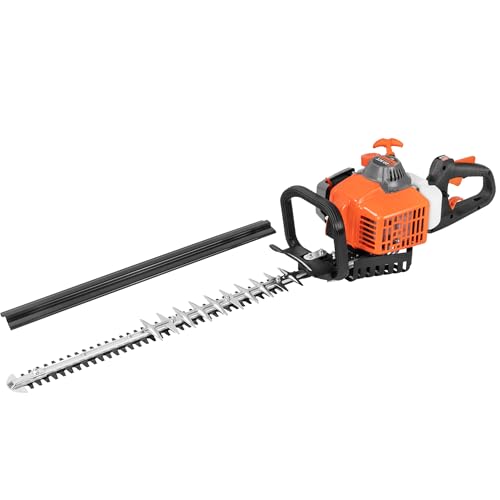
Awkward hedges are what this one is for. PROYAMA lists a rear handle that rotates a full 180 degrees with the stated aim of letting you cut tops, sides and undergrowth from the same grip. Compare that to the 90-degree rotation TdiriNar claims and the plain adjustable handle on the 122HD60, and PROYAMA has the widest claimed range of the group.
The listed size is 25.4cc, and PROYAMA describes a 1 HP two-cycle engine, dual-action 25-inch steel blades and an anti-vibration system. Note the mismatch worth knowing about: the specification field reads 25.4cc while a feature bullet says 22.5CC. When a listing contradicts itself on displacement, treat the smaller figure as your planning number. Dimensions are 12.2 x 45.3 x 12.6 in, making it the widest and tallest body here, and it sits in the more expensive half of the set.
PROYAMA states 11.7 lbs in a feature bullet, but there is no weight in the specifications, so that is a marketing claim rather than a confirmed figure. That is the trade-off against the two Husqvarnas and the SENIX, all of which publish weight properly. There is no warranty term either.
Pros:
- Widest claimed handle rotation in the set at 180 degrees
- 25 in dual-action steel blades per the listing
- Anti-vibration system listed by the manufacturer
- Two-cycle engine keeps maintenance simple
Cons:
- Listing contradicts itself: 25.4cc versus 22.5CC
- Weight appears only as a claim, not a published specification
- Widest and tallest body here at 12.2 x 12.6 in
- No warranty term published
5. Baotree 24-Inch 36cc 2 Cycle Gas Powered Dual Sided Hedge — Best minimal setup
The largest engine in this comparison at 36cc, paired with a 24-inch double-edged serrated blade.

Best for: dense overgrown shrubs on a bigger property Skip it if: you cut for more than short bursts at a time
If displacement is your yardstick, this is the top of the pile. 36cc is the largest published engine size here, ahead of the SENIX at 26.5cc and well ahead of the 122HD60 at 21.7cc. Baotree pairs it with a 24-inch double-edged serrated blade, which ties the longest fully specified cutting bar in the group alongside the 26cc sibling.
Baotree's claims run enthusiastic. The listing says the engine cuts 1-inch branches, delivers 300% more torque than electric models, and that an anti-vibration handle cuts fatigue by 40% over an hour of use. Those are the manufacturer's numbers, unverified, and the fatigue figure has no stated basis. The more useful claims are structural: a reinforced magnesium alloy gearbox with an anti-rust coating, and a three-part safety system of instant brake, throttle lock and hand guard. A metal gearbox is a real durability signal on a machine that lives in wet hedges.
Setup is genuinely simple, since a two-cycle engine means you mix fuel and go, with no oil reservoir to monitor. The problem is the 16 lb weight, which ties the heaviest here while carrying that big engine. Baotree also lists model OO-HT260-O on both the 36cc and 26cc versions, which muddies parts ordering.
Pros:
- Largest published engine size in the set at 36cc
- 24 in double-edged serrated blade ties the longest specified bar
- Reinforced magnesium alloy gearbox with anti-rust coating
- Instant brake, throttle lock and hand guard listed
- Two-cycle simplicity, no oil reservoir to check
Cons:
- Ties the heaviest published weight at 16 lb
- Shares model code OO-HT260-O with the 26cc version
- Fatigue and torque percentages are unsupported claims
- No warranty term published
6. Baotree 24-Inch 26cc 2 Cycle Gas Powered Dual Sided Hedge — Best for pros
The same 24-inch blade and magnesium gearbox as the 36cc Baotree, with a smaller engine and a lower price position.

Best for: a second machine kept in the trailer as a backup Skip it if: you want the strongest engine size in the set
This is the 36cc Baotree with a smaller engine, and knowing that is most of the decision. Same 24-inch double-edged serrated blade, same 9 x 42 x 9 in body, same model code, same magnesium alloy gearbox and anti-rust coating, same three-part safety system of brake, throttle lock and hand guard. The engine drops to 26cc and the price drops with it, into the cheaper half of this set.
For a crew keeping a spare in the trailer, that maths works. You get the full 24 in of blade, which matters more on a fast pass than the extra 10cc, and you spend less on a machine that spends most of its life waiting. The two-cycle engine means no oil level to forget after months in storage. Baotree makes the same 1-inch branch claim and the same one-hour continuous-use claim as the bigger model, both unverified.
Two things hold it back. Baotree publishes no weight for this one, only the 42-inch body length, so if you are weight-sensitive you are buying blind. It is also the slowest seller of the seven by a wide margin, which usually means the 36cc version is soaking up the attention. If you want the biggest engine in this comparison, that is its sibling, and this one gives up 10cc for the saving.
Pros:
- Same 24 in serrated blade as the 36cc version
- Magnesium alloy gearbox with anti-rust coating
- Brake, throttle lock and hand guard all listed
- Cheaper position than the 36cc sibling
- Two-cycle engine, no oil reservoir to monitor
Cons:
- No published weight anywhere on the listing
- 10cc less engine than the 36cc version
- Slowest seller of the seven picks here
- Shared model code complicates parts ordering
7. TdiriNar 2 Cycle Gas Hedge Trimmer — Best budget pick
The cheapest of the seven, with a claimed 25-inch double-sided blade and a 90-degree rotating rear handle.

Best for: a small hedge run and the lowest outlay here Skip it if: you want published weight or warranty figures
This is the cheapest pick in the set, and it earns the slot on blade length for the money. TdiriNar lists a 25-inch double-sided blade and a 22cc two-cycle engine in a 5.9 x 44.5 x 9.4 in body, which is the narrowest body of the seven at 5.9 in. Narrow helps when you are working between a hedge and a fence line.
The listing claims a 0.65 kW motor, built-in shock absorbers, a contoured grip, a 90-degree rotating rear handle for angled cuts, a safety stopper that blocks debris and cooling holes to prevent overheating. Construction is described as high-quality plastic and iron with a sprayed finish. Take the specification claims with care: one bullet says the blades slice branches up to 25.59 in diameter, which is a unit error rather than a capability, since 25.59 in is 650 mm and no handheld hedge trimmer cuts a tree that thick.
The real gap is what is missing. There is no published weight, no warranty term and no cutting capacity you can trust, which puts it behind the SENIX on every count except price. Against the 122HD60 you are trading a full spec sheet and a documented starting system for the lowest outlay in this comparison. If your hedge is a single short run cut twice a year, that may be the right trade. For anything larger, spend up.
Pros:
- Cheapest of the seven picks here
- Claimed 25 in double-sided blade, longest claim in the set
- Narrowest body at 5.9 in for tight fence gaps
- 90-degree rotating rear handle for angled cuts
Cons:
- No published weight anywhere on the listing
- No warranty term published
- Cutting capacity claim contains an obvious unit error
- Smallest engine claim in the set at 22cc
Weight is the specification that limits your session
Only four of these seven listings publish a weight. That gap tells you something about the category, and it also tells you which listings to trust.
Here is the published spread, lightest first:
- SENIX 4QL: 9.4 lb
- Husqvarna 122LKH: 15 lb
- Baotree 36cc: 16 lb
- Husqvarna 122HD60: 16.2 lb
PROYAMA claims 11.7 lbs in a feature bullet but does not list it as a specification. The 26cc Baotree and the TdiriNar publish nothing at all.
Weight decides how long you cut, not whether you cut. Every machine here will get through a 1-inch branch. None of them will let you hold 16 lb at eye level for an hour. So work backwards from your hedge: measure the tallest point, decide whether the blade will be above or below your shoulders, and pick your weight from there.
Anti-vibration matters for the same reason, and five of the seven listings mention it. The Husqvarna 122HD60 calls out dampeners specifically to reduce stress on arms and hands. Vibration is what turns a 30-minute job into numb fingers by lunchtime, and it compounds with weight rather than substituting for it.
What does a rotating rear handle really change?
A rotating rear handle changes your wrist angle on vertical cuts, and that is a bigger deal than it sounds.
When you cut the side of a hedge with a fixed handle, your wrist has to rotate roughly 90 degrees to keep the blade flat against the face. Hold that position and your forearm fatigues fast. A rotating handle lets the grip turn instead of your wrist.
Here is what each pick offers:
- PROYAMA: 180-degree rotation, the widest claim in the set
- Husqvarna 122LKH: 180-degree head adjustment, one-handed
- TdiriNar: 90-degree rotation
- SENIX: rotating rear handle, degrees not stated
- Husqvarna 122HD60: adjustable rear handle for sides and top
The two Baotree units do not mention handle rotation. If you cut a lot of hedge faces rather than tops, treat that as a real omission and lean toward PROYAMA or the 122LKH.
One caution on the 180-degree claims. Rotation range only helps if the lock is solid, and no listing here publishes a detent count or a locking mechanism description. You are trusting the number.
Two-cycle or four-cycle: which do you want?
Six of these seven run two-cycle engines. The SENIX 4QL is the only four-cycle, and the split is a real fork in the road.
Two-cycle, meaning six of the seven picks:
- You mix gas and oil at the ratio the manual specifies, every fill.
- There is no oil reservoir and no dipstick, so nothing to check before starting.
- Get the ratio wrong and you can damage the engine, which is the whole risk.
Four-cycle, meaning the SENIX only:
- Straight gas in the tank, no mixing at all.
- Oil lives separately and needs level checks and periodic changes.
- SENIX says the 4QL design keeps the motor lubricated at any angle without stalling or oil leakage, which matters on a tool you hold sideways.
Choose two-cycle if you already run other mixed-fuel gear and have a can made up. Choose the four-cycle SENIX if this is your only gas tool and you would rather not keep premix around. A can of mixed fuel that has sat for a season is one of the most common reasons a hedge trimmer will not start in spring.
What none of these listings tell you
Six of these seven listings publish no warranty term. Only the SENIX states one, at 3 years limited. That single fact reshuffles the field for anyone who cares about support after year one.
Nobody publishes a decibel figure. Gas hedge trimmers are loud, all of them, and if you have close neighbours or a homeowners association with noise hours you are guessing. Plan on hearing protection regardless of which you pick.
Nobody publishes cutting capacity in a comparable way either. SENIX states 1-1/8 in, the two Baotrees claim 1 inch branches, and the rest state nothing usable. TdiriNar's 25.59 in figure is a unit conversion error. If your shrubs have woody stems near an inch thick, the SENIX figure is the only one on the page you can actually plan against.
Nobody publishes fuel tank capacity, so run time per fill is unknown across the whole set. And nobody publishes a duty rating, which is exactly why the heavy duty part of a heavy duty gas hedge trimmer search has to be judged from blade length, displacement and gearbox material rather than taken on trust from the word itself.
The verdict
The Husqvarna 122HD60 is the best heavy duty gas hedge trimmer here, and the reason is completeness. It is the only pick that publishes blade length, weight, engine size, dimensions and model number together, and it backs that with the most thoroughly described starting system in the set: Smart Start recoil, carburettor air purge and an auto-resetting stop switch. At 23.7 in it also has the longest blade of any machine here that publishes one as a specification rather than a claim.
Two conditions flip that recommendation, and they are both about height and endurance.
If your cutting happens above shoulder level, buy the SENIX 4QL instead. Its 9.4 lb published weight is 6.8 lb under the Husqvarna, and above shoulder height that gap decides whether you finish. The 3-year limited warranty and the four-cycle engine that needs no fuel mixing are the SENIX's other exact advantages over the winner.
If your hedge tops sit above your eyeline, buy the Husqvarna 122LKH. Its 89.7-inch body puts the 21-inch blades up there while you stay on the ground, which removes ladder work from the job entirely. That is a safety gain no handheld in this comparison can match, and it is worth the shorter blade.
FAQ
Is a heavy duty gas hedge trimmer worth it over a cordless one?
A heavy duty gas hedge trimmer is worth it when hedge length beats battery capacity. Gas gives you unlimited run time from a fuel can rather than a charge cycle, which matters on long boundary runs. Baotree claims its two-stroke engine delivers 300% more torque than electric models. If your hedge is a single short run, cordless is easier to live with.
Which gas hedge trimmer gives the most blade for the least money?
The most blade for the least money here is the TdiriNar, the cheapest of the seven, with a claimed 25-inch double-sided blade. The catch is that it publishes no weight, no warranty and no usable cutting capacity. The SENIX, second-cheapest, gives you 22 in of blade plus a 9.4 lb weight and a 3-year limited warranty, which is a stronger overall package.
What blade length do I need for a 1-inch branch?
Blade length does not determine whether you can cut a 1-inch branch. Blade gap and tooth spacing do. SENIX publishes a 1-1/8 in cutting capacity, and both Baotree units claim 1-inch branch capability. Blade length only affects how much hedge face you cover per pass, so pick length for hedge size and capacity for stem thickness.
Husqvarna 122HD60 or SENIX 4QL: which should I buy?
Choose the 122HD60 or SENIX 4QL by hedge height. The Husqvarna gives you 23.7 in of blade, a full published spec sheet and a documented starting system, at 16.2 lb. The SENIX weighs 9.4 lb, needs no fuel mixing, and carries the only published warranty at 3 years. Below chest height, take the Husqvarna. Above shoulder height, take the SENIX.
What mistake do first-time gas hedge trimmer buyers make?
The mistake first-time gas hedge trimmer buyers make is shopping engine displacement instead of weight. A 36cc machine sounds stronger than a 21.7cc one, and both cut a 1-inch branch fine. But the 36cc Baotree weighs 16 lb against 9.4 lb for the SENIX, and that gap ends your session long before either engine runs short of power.
Measure the tallest point of your hedge this weekend, before you buy anything. That one number tells you whether you want the Husqvarna 122HD60 at 16.2 lb, the 9.4 lb SENIX, or the 89.7-inch reach of the 122LKH, and it is the only measurement that changes the answer. The 122HD60 stays my default because it is the one listing here where every number you need is actually printed, and on a two-cycle machine you will own for a decade, a spec sheet you can check beats a bullet point you have to believe.